
Table of Contents
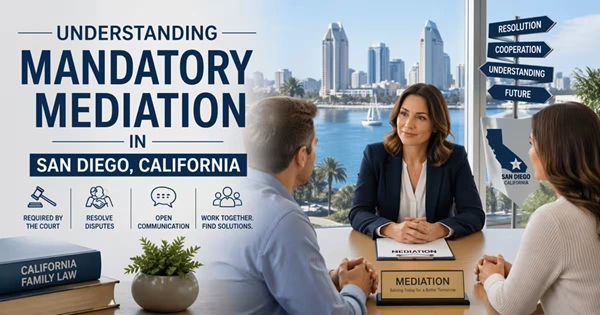
Understanding Mandatory Mediation in San Diego County – If you have a pending child custody case at the San Diego Superior Court, you will likely be referred to Family Court Services (FCS). In San Diego, mediation isn’t just a suggestion—it is a legal requirement before a judge will make a final ruling on your parenting plan.
Navigating this process requires a strategy tailored to San Diego’s unique court culture. To find an advocate who understands these local nuances, see our list of the Top Family Law Attorneys in San Diego, or consult our primary hub: Family Law in California: A Complete Guide to Your Legal Rights (2026 Edition).
1. Family Court Services (FCS) vs. Private Mediation
In San Diego, the court-mandated process is officially called Child Custody Recommending Counseling (CCRC), though most locals simply call it “FCS.”
- The Recommending Factor: Unlike some counties where mediation is confidential, San Diego is a “recommending” county. This means if you and the other parent cannot agree, the counselor will write a formal recommendation to the judge.
- The Impact: Judges in San Diego place heavy weight on these recommendations. Your performance in this session can shape your custody schedule for years to come.
2. The San Diego Procedural Path
The San Diego Superior Court (Central, North County, East County, and South County) follows a strict timeline for 2026:
- Online Orientation: Before your FCS appointment, you must complete the mandatory online orientation. Failure to do so can result in your mediation being rescheduled and your court date being delayed.
- The Intake Questionnaire: You must submit a detailed intake form at least five days before your appointment. This is where you first outline your desired parenting schedule.
- The FCS Session: These are currently held in person at your respective courthouse (e.g., the Central Courthouse downtown or the Vista branch).
3. Mandatory Settlement Conferences (MSC)
Unique to the San Diego system is the Mandatory Settlement Conference (MSC). While FCS handles custody, the MSC handles the “business” of the divorce—property division and alimony.
- The Settlement Judge: San Diego often utilizes “Judges Pro Tem”—experienced local attorneys—to act as neutral evaluators.
- Finality: The goal of an MSC is to resolve your case without a trial. If you reach a settlement here, it is put “on the record” immediately.
4. Military Nuances in San Diego
Given our large military community, San Diego FCS counselors are specially trained in the Servicemembers Civil Relief Act (SCRA).
- Deployment & PCS: If you are active duty and stationed at 32nd Street, North Island, or Camp Pendleton, the court provides specific protections regarding your ability to attend mediation.
- Flexible Parenting Plans: 2026 San Diego guidelines emphasize “Family Care Plans” that account for deployments, ensuring that the child’s bond with the service member is protected even during duty assignments.
Top Tips for a Successful San Diego Mediation
- Avoid “Parent Alienation”: San Diego counselors look for parents who support the child’s relationship with the other parent.
- Be Specific: Instead of saying “I want more time,” bring a printed calendar showing a 2-2-3 or 5-2-2 schedule that accounts for San Diego school district holidays (like SDUSD or Poway Unified).
- Focus on the “Best Interests”: In 2026, the court is increasingly focused on emotional stability and “continuity of care.”