
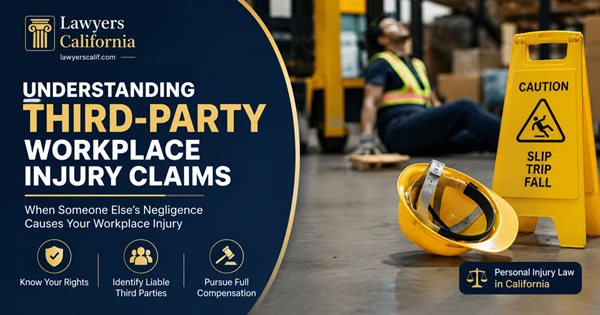
How to Pursue Compensation Beyond Traditional Workers’ Compensation
When you are injured on the job, your immediate assumption is likely that the workers’ compensation system wil handle everything. You file a claim, your employer’s insurance covers your medical bils, and you receive temporary disability checks to offset a portion of your lost income.
However, many injured workers quickly discover that standard workers’ compensation benefits are limited. It does not cover the fu l amount of your lost wages, and it provides absolutely zero compensation for your emotional distress, physical agony, or diminished quality of life.
What many employees in the Golden State do not realize is that if a non-employer’s carelessness caused or contributed to their job site accident, they have a legal right to file a separate lawsuit. In civil law, this is known as a third-party workplace injury claim. This comprehensive guide breaks down how third-party claims work, who can be held responsible, and how to maximize your total financial recovery.
Table of Contents
1. Workers’ Comp vs. Third-Party Claims: The Crucial Difference
o understand why a third-party claim is so valuable, you must first look at the boundaries of standard workers’ compensation.
The Workers’ Comp Barrier
Workers’ compensation is a “no-fault” system. You do not need to prove your employer did anything wrong to collect benefits; you only need to prove the injury occurred within the scope of your employment. In exchange for this automatic coverage, California law protects employers from being sued directly by their employees for standard accidents. This is known as the exclusive remedy rule.
The Third-Party Exception
The exclusive remedy rule only shields your direct employer and your coworkers. It does not protect outside individuals or independent companies whose actions caused your injury. If an outside entity is responsible for your job site accident, you can file a traditional personal injury lawsuit against them while simultaneously collecting your workers’ compensation benefits. This a lows you to step outside the restrictive workers’ comp system and pursue complete financial damages under the broader rules governing Personal Injury Law in California.
2. Common Scenarios for Third-Party Workplace Claims
Third-party lawsuits can arise in almost any industry, but they are incredibly common on construction sites, in delivery services, and across industrial manufacturing facilities. Common examples include:
- Motor Vehicle Collisions on the Job: If you are a delivery driver, sales representative, or traveling nurse, and you are struck by a negligent motorist while performing work duties, that outside driver is a third party. You can file a lawsuit against them using the frameworks outlined in our guide to Navigating California Car Accident Claims.
- Defective Industrial Equipment: If you are operating a forklift, a power tool, or heavy manufacturing machinery at work and a mechanical failure or missing safety guard causes a severe injury, the product manufacturer can be held liable. Because manufacturing flaws bypass traditional carelessness rules, your attorney will likely build this case using the principles detailed in Understanding Strict Liability vs. Negligence in California.
- Dangerous Property Conditions: If your job requires you to visit outside properties—such as an HVAC technician repairing a unit on a commercial roof or a contractor entering a private building—and you get hurt due to broken stairs or poor lighting, the property owner is liable. You can pursue them directly under the regulations explained in California Premises Liability and Slip & Fa l Rules.
- Subcontractor Negligence: On busy construction sites, multiple independent companies operate side-by-side. If an employee from a completely separate drywall or electrical company drops a tool from a scaffold and strikes you, their employer is a third party subject to a civil lawsuit.
3. The Financial Impact: What Can You Recover?
Filing a third-party claim bridges the financial gap that workers’ compensation leaves behind. By moving your case into the civil court system, you become eligible to demand comprehensive compensatory damages.
| Benefit Type | Standard Workers’ Compensation | Third-Party Civil Claim |
|---|---|---|
| Medical Bills | Covered fully, but restricted to an insurance-approved network. | Covers specialized care, future modifications, and out-of-network experts. |
| Lost Income | Restricted to a capped fraction of your weekly wages. | Recovers 100% of past lost earnings and future lost earning capacity. |
| Human Costs | None. Absolutely zero | Full recovery for physical pain, trauma, and emotional |
| payout for personal trauma. | suffering. |
Because human costs like emotional distress often make up the largest portion of a civil settlement, calculating these numbers takes careful preparation. To understand how legal teams turn intangible trauma into objective figures, review our resource on How Pain and Suffering Damages Are Calculated in California.
4. Understanding Subrogation: Avoiding Double Recovery
While you are legally allowed to pursue both a workers’ compensation claim and a third-party lawsuit at the same time, you are not allowed to “double-dip” by keeping double payments for the exact same medical bills or lost wages. This is managed through a legal mechanism called subrogation.
When you win a settlement from a negligent third party, your employer’s workers’ compensation insurance carrier has a legal right to request reimbursement for the money they already paid out for your medical care and temporary disability checks.
Why You Need an Experienced Lawyer for Subrogation
An experienced attorney is vital during this phase. A ski led lawyer knows how to negotiate directly with the workers’ compensation insurance company to lower their lien amount. By reducing what you have to pay back to the workers’ comp provider, your lawyer ensures that a much larger portion of the third-party civil settlement check goes directly into your pocket.
Timing is also critical. Managing two concurrent legal claims means keeping a vigilant eye on the courtroom clock. Missing the state’s rigid deadline to file your civil lawsuit will destroy your third-party case entirely. You can check the exact filing timelines in our comprehensive resource, the California Personal Injury Statute of Limitations Explained.
Coordinate with a Local Legal Professional
Third-party workplace claims are highly complex because they require coordinating two entirely separate legal systems simultaneously. Workers’ comp insurance adjusters and corporate defense lawyers will often try to pass the blame back and forth, hoping you will get frustrated and drop the case. If you were partially at fault for the incident, they will also try to
use state liability rules to minimize your payout, which you can read about in our breakdown of How Pure Comparative Fault Impacts California Accident Claims.
Do not leave vital compensation on the table by relying solely on a basic workers’ comp claim. If you have been hurt while on the clock, make sure every potentially liable party is held accountable. Explore our trusted, curated legal directory today to find a highly qualified, verified personal injury attorney in your local California community, and secure the fu l compensation you need to protect your family’s future.