
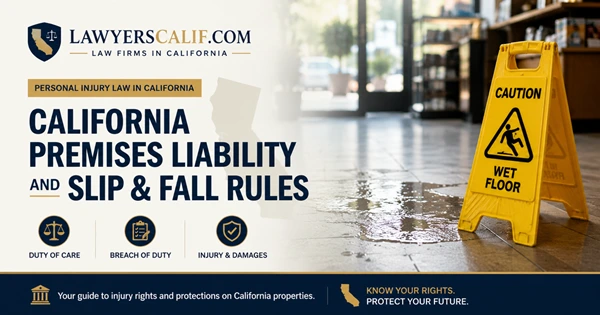
Understanding Property Owner Responsibility and Your Rights After a Property Injury
California Premises Liability And Slip &Fall Rules – A trip to the local grocery store, a walk through a retail center, or a visit to an apartment complex should never end in an emergency room visit. Yet, poorly maintained walkways, ignored liquid spills, and broken stairs cause thousands of severe injuries across California every year.
When you are hurt on someone else’s property, your path to financial recovery falls under a specific branch of civil law known as premises liability. Many people mistakenly believe that if they fall on a business property, the owner is automatically responsible for the medical bills. In reality, California property injury claims require proving that a property manager or owner failed to maintain a safe environment.
This comprehensive guide outlines how California premises liability rules work, the legal duties of property owners, and how to build a strong claim for compensation if you are injured.
Table of Contents
1. The Legal Standard for Property Safety in California
In many states, your legal rights after a property injury depend entirely on why you were on the property—whether you were a paying customer, a social guest, or a trespasser. California completely rejected this traditional system in the landmark case Rowland v. Christian.
Under current California law, specifically Civil Code Section 1714, a l property owners, managers, and occupiers owe a general duty of care to maintain their premises in a reasonably safe condition.
Instead of focusing strictly on your visitor status, California courts look at whether the property owner acted as a reasonable person would have under similar circumstances. To win a premises liability claim, your legal team must establish four core facts:
- Control: The defendant owned, leased, occupied, or controlled the property.
- Negligence: The defendant was careless in the maintenance or inspection of the property (creating or a lowing a dangerous condition to exist).
- Harm: You sustained an actual, documented injury.
- Causation: The defendant’s failure to maintain the property was a substantial factor in causing your injury.
This standard forms a major branch of the broader legal framework outlined in our master resource, Personal Injury Law in California.
2. Proving “Notice” in a Slip and Fall Case
The most difficult hurdle in a slip and fall claim is proving that the property owner actually knew—or should have known—about the hazard before you fell. In legal terms, this is called establishing notice.
Property owners cannot fix a problem they do not know exists. Notice is generally broken down into two categories:
Actual Notice
This means the owner or an employee was fully aware of the danger. For example, if a customer tels a grocery store manager that a milk jug broke on aisle 4, and the manager fails to clean it or block off the aisle, the store has actual notice of the hazard.
Constructive Notice
This is far more common in slip and fal lawsuits. Constructive notice means the hazard existed for a long enough period that a reasonable property owner should have discovered and fixed it during routine safety inspections.
How a Lawyer Proves Constructive Notice:
To prove an owner should have known about a danger, an attorney will dig into store records, examining sweep logs, security camera footage, and employee training manuals. If store video shows that a puddle of water sat on a department store floor for forty-five minutes without a single employee checking the area, your lawyer can argue the store is liable due to constructive
notice.
3. How Core California Laws Influence Property Claims
A successful property injury claim must be structured around the specific statutes that govern civil lawsuits in the state:
- Shared Blame: Property owners regularly try to shift the blame to the victim, arguing that you should have looked where you were walking or that you were distracted by your phone. However, even if you were partially distracted, California’s victim-friendly pure comparative negligence standard ensures you can still collect compensation. Your final settlement will simply be reduced by your percentage of responsibility. You can learn more about this blame-shifting math in our detailed guide, How Pure Comparative Fault Impacts California Accident Claims.
- The Legal Clock: Building a case takes time, and you must act before strict statutory windows close. Under state law, you generally have a specific timeframe to either settle your case or file a lawsuit. Review these critical deadlines in our resource, the California Personal Injury Statute of Limitations Explained.
- Measuring Your Losses: Property injuries like torn ligaments or broken bones often carry heavy emotional tolls. Your final financial package is split into tangible bi ls and intangible human costs. For an look at how insurance adjusters value these quality-of-life impacts, see How Pain and Suffering Damages Are Calculated in California.
4. Common Dangerous Conditions on California Properties
Premises liability covers much more than a wet floor in a supermarket. Property owners can be held legally accountable for a wide range of hidden dangers, including:
- Structural Failures: Broken handrails on stairwells, rotting wood on apartment balconies, uneven concrete walkway slabs, or torn carpeting in building hallways.
- Inadequate Lighting: Poorly lit staircases, dark parking lots, or dim building entryways that obscure steps or hide criminal activity.
- Inadequate Security: If a business located in a high-crime area fails to provide security guards, working locks, or proper fencing, they may be liable if a visitor is assaulted on the premises.
- Hidden Hazards vs. Strict Liability: Property hazards usually require proving carelessness. However, if your injury on a property involves an aggressive animal or a defective consumer installation, the rules shift completely to a no-fault tracking system. To understand this difference, explore our guide on Understanding Strict Liability vs. Negligence in California.
Steps to Take Immediately After a Property Injury
If you trip, slip, or fa l on a commercial or residential property, the actions you take immediately after the incident wi l heavily dictate the strength of your claim:
- Report the Incident Immediately: Demand that the manager, owner, or landlord fil out an official incident report. Request a physical copy before you leave the premises.
- Photograph the Hazard: Use your smartphone to take close-up photos and videos of the exact condition that caused you to fall (e.g., the puddle of liquid, the broken step, the lack of warning signs). Property owners wil fix the hazard immediately after you leave, destroying vital visual evidence.
- Collect Witness Information: If other customers or bystanders saw you fall or noticed the hazard, secure their names and phone numbers.
- Seek Medical Care: Go to an urgent care or emergency room right away. Documenting your physical injuries immediately prevents insurance companies from claiming you got hurt somewhere else.
Partner with a Local Legal Advocate
Insurance companies for major retail chains, supermarkets, and commercial landlords employ aggressive legal teams trained to deny premises liability claims. They wi l often try to blame your footwear, argue the hazard was “open and obvious,” or claim you were trespassing.
You do not have to go head-to-head with corporate insurance adjusters alone. Working with an experienced legal team ensures that vital evidence like security footage is legally preserved before it gets deleted, and that your rights are fully protected.
If you or a loved one is recovering from a property-related injury, secure the support you deserve. Explore our trusted legal directory today to find a highly qualified, verified personal injury attorney in your local California community, and take the first step toward a full financial recovery