
Table of Contents
Medi-Cal Asset Limits Explained: What is the Community Spouse Resource Allowance? – When a married individual requires long-term care in a skilled nursing facility, the primary worry for the family shifts immediately to the well-being of the partner remaining at home. How will they afford basic living expenses if their shared lifetime savings must be completely liquidated to pay for care?
To prevent this devastating scenario, federal and state laws established Spousal Impoverishment Protections. At the center of these protections is a powerful financial tool known as the Community Spouse Resource Allowance (CSRA).
Understanding how the CSRA works within California’s newly updated asset framework is the key to qualifying for Medi-Cal long-term care while legally protecting your home and nest egg.
Defining the Terms: Who is Who?
To understand how Medi-Cal allocates financial allowances, it helps to understand the official state terminology:
- The Institutionalized Spouse: The partner who requires a level of care provided in a nursing home or through specific long-term care home waivers.
- The Community Spouse: The partner who remains living in the community (e.g., in the family home, an apartment, or an assisted living facility) and does not require Medi-Cal long-term care services.
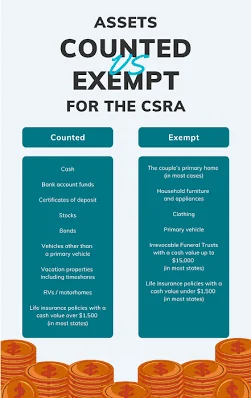
Assets Counted vs. Exempt for the CSRA. Source: Elder Law Answers
How the CSRA Protects the At-Home Partner?
The Community Spouse Resource Allowance dictates the maximum amount of countable, joint liquid assets the spouse at home is legally permitted to retain when the other spouse applies for Medi-Cal long-term care.
Under standard Medi-Cal rules for an individual, an applicant is only allowed to keep a maximum of $130,000 in countable assets. However, if that applicant has a spouse at home, forcing them to live on only $130,000 would create severe financial hardship.
California’s 2026 Spousal Allowances
- Community Spouse Resource Allowance (CSRA): Up to $157,920 in countable assets can be completely protected in the community spouse’s name.
- Institutionalized Spouse Limit: The applying spouse is allowed to keep up to $130,000.
- Total Combined Protected Assets: Together, a married couple can safely retain up to $287,920 in liquid, countable assets at the time of application.
Countable vs. Exempt Assets under CSRA Rules
The CSRA only applies to assets that Medi-Cal considers countable. As shown in the visual guide above, your assets are divided into two distinct categories:
1. Completely Exempt (Automatically Protected)
These do not count toward the $157,920 CSRA limit, meaning the community spouse keeps them regardless of value:
- The Primary Home: Exempt as long as the community spouse lives in it.
- One Primary Vehicle: Totally exempt for transport to medical appointments and daily errands.
- Personal Property: Furniture, clothing, appliances, and wedding rings.
2.Countable Assets (Subject to the CSRA Cap)
These are liquid or semi-liquid holdings that must fit under the combined limit:
- Cash, checking accounts, and savings accounts.
- Certificates of Deposit (CDs), stocks, bonds, and mutual funds.
- Secondary real estate (vacation homes, undeveloped land, or non-commercial rental properties).
Managing Overage: What If You Exceed the CSRA Limit?
If a couple’s total countable assets exceed the combined $287,920 threshold, they cannot simply gift the extra money to children or relatives to qualify. Doing so within the 30-month lookback period triggers severe transfer penalties.
Instead, the couple must execute a strategic, legal spend-down. This can involve converting countable cash into exempt assets, paying off old marital debts, or utilizing a specialized Spousal Annuity.
A Medi-Cal Compliant Annuity takes a chunk of excess countable cash and converts it into a regular stream of monthly income for the community spouse. Because the cash is transformed into income, the asset instantly drops off Medi-Cal’s radar, allowing the institutionalized spouse to qualify immediately.
Looking for the Full Picture? For an overview of how these spousal protections fit into the broader system, check out our central hub page, “Elder Law in California: A Complete Strategic Guide.”