
Table of Contents
How California Residents Can File a Claim under CCPA
Fidelity Data Breach Payouts – Under the California Consumer Privacy Act, the range of statutory damages awarded to private citizens for data breaches caused by poor security sits between $100 and $750 per consumer per incident, and that number is exactly why Fidelity data breach payouts have become a serious conversation for California residents right now. If you held an account with Fidelity Investments brokerage service and your personal information was exposed, understanding how California residents can file a claim under CCPA is the first step toward recovering what the law says you are owed.
Navigating the California legal system can be incredibly overwhelming, especially when a breach notice lands in your inbox with more legal jargon than plain answers.

Key Takeaways
| Question | Quick Answer |
| Can I file a CCPA claim for a Fidelity data breach? | Yes, if your unencrypted personal information was exposed through the negligence of a business operating in California, including a Fidelity brokerage firm. |
| What is the payout range under CCPA? | Statutory damages run from $100 to $750 per consumer per incident, and actual damages can be pursued on top of that. |
| Do I need a lawyer to file? | Not always, but lawyers in California who focus on data breach litigation dramatically improve outcomes for larger, complex claims. |
| Is there a deadline to file? | Yes, California’s statutory deadlines apply, and waiting too long can forfeit your right to compensation entirely. |
| What if I don’t know if my data was part of a Fidelity brokerage services breach? | Check the notification letters mailed to you, or contact the company directly to confirm whether you were an affected consumer. |
| Can multiple residents join together? | Yes, class action attorneys in California frequently consolidate individual claims into a single, more powerful case. |
| Where can I find vetted representation? | Our directory of California attorneys is engineered to simplify that search across the Golden State. |

What Triggered the Fidelity Data Breach Claims in California
Fidelity brokerage services, like most large financial institutions, store enormous volumes of personal and financial data. Names, Social Security numbers, account balances, and login credentials all sit inside the same systems that power your trades and retirement contributions.
When that infrastructure is breached, either through a vendor failure, a phishing attack, or an unpatched vulnerability, the exposure often spans hundreds of thousands of accounts at once. California law treats this kind of failure differently than most other states, because the CCPA gives consumers a private right of action when a business fails to maintain reasonable security procedures.
That right of action is what makes Fidelity data breach payouts possible for California residents in the first place. Without it, most consumers would have to rely solely on the state Attorney General to act on their behalf.
Understanding Your Rights Under CCPA Fidelity Data Breach Payouts
The CCPA does not require you to prove financial loss to recover statutory damages. That distinction matters enormously.
Most privacy laws force consumers to show they lost money because of identity theft or fraud. California instead lets you recover between $100 and $750 per incident simply because your data was exposed through inadequate security, regardless of whether a criminal has used it yet.
- Statutory damages: $100 to $750 per consumer per incident, decided by a court based on factors like the nature of the violation.
- Actual damages: Available if you can document real financial harm, such as fraudulent charges or credit monitoring costs.
- Injunctive relief: A court order requiring the company to fix its security practices going forward.
Recent data backs up how often financial firms end up in this exact position. Over 34% of all CCPA lawsuits initiated in a recent tracked year were brought against businesses in the financial services industry, the same category Fidelity brokerage services falls into.
Did You Know?
Over 34% of all CCPA lawsuits filed in a recent tracked year targeted financial services businesses, the same industry category as Fidelity brokerage services.
Source: ShardSecure

How Fidelity Brokerage Services Handles Consumer Data
Fidelity Investments brokerage service manages retirement accounts, brokerage accounts, and financial advisory relationships for millions of clients nationwide. That scale is exactly why a single Fidelity brokerage firm incident can affect a meaningful share of California’s population in one event.
When a breach notification arrives, read it carefully. Look for the specific categories of information exposed (Social Security numbers carry more weight than an email address alone), the date range of the exposure, and whether the company is offering free credit monitoring.
These details directly affect the strength of your claim and the amount you may be entitled to under a data breach settlement in 2026.
Step-by-Step: How California Residents Can File a Claim under CCPA
Filing correctly matters as much as filing at all. Here is the process we see work most consistently for California residents pursuing Fidelity data breach payouts.
- Confirm your inclusion. Locate the official breach notification letter or check Fidelity’s public breach disclosures.
- Send a pre-litigation notice. The CCPA requires consumers to give the business 30 days to cure the violation before a lawsuit for statutory damages proceeds.
- Document your exposure. Save the notification letter, screenshots, and any evidence of suspicious account activity.
- Consult an attorney. Class action attorneys in California can evaluate whether your claim fits into an existing consolidated case or stands better on its own.
- File within the deadline. California’s statutes of limitations for CCPA-based claims are strict, and missing them ends your claim permanently.
They lean hard on insurers and move fast once the paperwork is in order. Slow-walking any one of these steps is the most common way a valid claim gets weakened before it ever reaches a settlement table.
What Compensation to Expect from the 2026 Data Breach Settlement Landscape
Payouts vary based on how the breach occurred, how many people were affected, and whether the company disputes liability. A large-scale data breach settlement in 2026 involving a financial institution typically resolves through one of two paths: individual statutory damages claims, or a negotiated class-wide settlement fund.
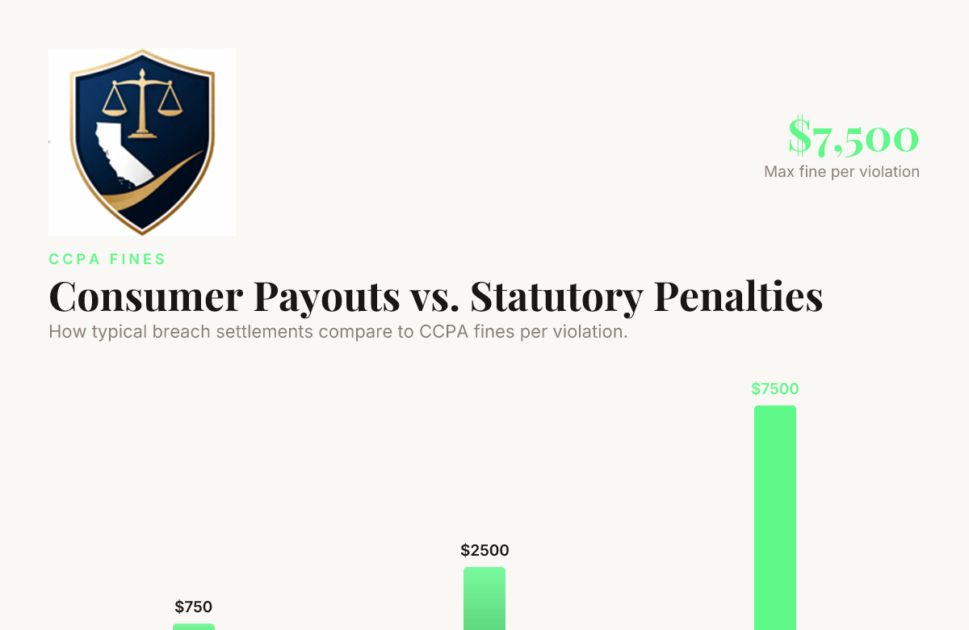
How typical breach settlements compare to CCPA fines per violation.
Individual claims tend to land toward the statutory range of $100 to $750, while class-wide settlements can distribute a lump sum across thousands of claimants, with per-person payouts depending entirely on how many people file. About 15% of businesses that report a breach to the California Attorney General end up facing consumer litigation, and more than 80% of the CCPA lawsuits filed in a recent tracked year followed directly from a filed breach notice.
We never promise a specific dollar figure, because every case turns on its own facts. What we can say is that the process rewards consumers who act early and document everything.

Why You Need Class Action Attorneys in California for Fidelity Claims
A single consumer going up against a Fidelity brokerage firm alone faces a steep uphill climb. Class action attorneys in California pool resources, share deep-dive discovery costs, and apply aggressive negotiation tactics that individual claimants simply cannot match.
An attorney who knows the tendencies of the local judiciary can provide an invaluable strategic advantage here. California’s CCPA litigation landscape moves differently than other states, and firms that specialize in this area understand which judges favor early settlement and which push cases toward trial.
You want a lawyer who fights hard and treats you with care, especially when you are one of potentially thousands of claimants in the same filing.
Choosing Between Lawyers in California and Law Firms in California for Your Claim
Not every case needs a massive firm, and not every case is well served by a solo practitioner either. Deciding between individual lawyers in California and larger law firms in California often comes down to the size and complexity of your claim.
Here is how we weigh the decision when evaluating representation for privacy and data breach matters:
- Case results and impact: 30% – Has the firm actually recovered payouts in similar CCPA or data breach matters?
- Trial power and negotiation history: 25% – Do they settle quickly, or do they have the resources to take a case the distance?
- Client service and communication: 20% – Fast updates, plain language, and respect for your time.
- Ethics and discipline record: 15% – A clean bar record matters more than flashy advertising.
- Fee transparency: 10% – Clear contingency fee terms with no surprise deductions.
Larger law firms in California often bring more case prep resources and dedicated privacy litigation teams to a Fidelity data breach payout claim, particularly when the case involves a class action. Smaller firms and solo lawyers in California can still be a strong fit for individual statutory damages claims where the amount in dispute is modest.
Did You Know?
The California Attorney General can seek civil penalties of $2,500 to $7,500 per violation, with the higher figure reserved for intentional CCPA violations.
Source: ShardSecure
Statutes of Limitations and Deadlines for CCPA Claims
Statutory deadlines are unforgiving in California civil litigation. Most CCPA-based claims follow a limitations period tied to when the breach was discovered, not necessarily when it occurred, so it is critical to confirm your specific timeline with counsel as soon as you learn of an exposure.
Businesses now face their own strict clock as well. Under SB 446, companies must notify affected California residents within 30 calendar days of discovering a breach, a much tighter standard than what existed even a few years ago.
That tighter notification window matters for your claim because it creates a clearer paper trail. Fewer than 10% of historical breaches would have met this rigorous 30-day standard, which tells you how much stricter California’s enforcement posture has become heading into 2026.
Common Mistakes That Weaken a Fidelity Data Breach Claim
We see the same errors repeated across privacy litigation cases in California. Avoiding them preserves the full value of your claim.
- Ignoring the notification letter. Throwing it away removes your primary piece of evidence.
- Waiting too long to act. Statutes of limitations do not pause because you are busy.
- Signing a settlement without review. Some initial offers from companies undervalue the statutory damages available.
- Skipping the pre-litigation notice. The CCPA’s 30-day cure period is a procedural requirement, not an optional step.
- Assuming you need proof of fraud. Statutory damages do not require you to show actual financial loss.
Finding localized counsel is critical to the outcome of your case, particularly because California’s privacy litigation rules and judicial preferences vary from courthouse to courthouse. That is exactly the kind of local expertise our directory is built to help you locate across the Golden State.
Conclusion
Fidelity data breach payouts represent a real, enforceable right for California residents whose personal information was exposed through inadequate security. Whether you are evaluating a modest individual statutory claim or considering joining a larger class action, understanding how California residents can file a claim under CCPA puts you in a far stronger position than waiting for a company to act on its own terms.
If your case is complex or severe, they set the pace, not you, so getting vetted legal advocate support early is worth the effort. Our directory of lawyerscalif.com connects California residents with attorneys who focus specifically on privacy and data breach litigation.
Frequently Asked Questions
How much can I actually get paid from a Fidelity data breach claim in California?
Under CCPA, statutory damages typically run between $100 and $750 per consumer per incident, though actual damages may push the total higher if you can document real financial harm. Class-wide settlements distribute funds differently depending on the total number of claimants.
Do I need to hire lawyers in California to file a CCPA claim?
You are not legally required to hire an attorney, but privacy litigation involves procedural steps like the 30-day cure notice that are easy to miss without guidance. Most California residents pursuing Fidelity data breach payouts work with lawyers in California who focus specifically on data breach and privacy law.
What is the deadline to file a CCPA claim after a Fidelity data breach?
California’s statutes of limitations for privacy claims are strict and generally run from the date of discovery of the breach. Waiting too long, even by a few months, can forfeit your right to statutory damages entirely.
Is a data breach settlement in 2026 different from earlier CCPA cases?
Yes, enforcement has tightened considerably, with stricter 30-day notification rules under SB 446 and larger fines like the $1.35 million penalty issued to Tractor Supply Company for CCPA violations. This more aggressive posture generally works in favor of California residents filing claims in 2026.
Can law firms in California combine my claim with other Fidelity customers?
Yes, law firms in California frequently consolidate individual CCPA claims into class actions when a breach affects a large number of people. Class action attorneys in California can evaluate whether your case is stronger individually or as part of a larger group filing.
What if I’m not sure whether Fidelity brokerage services exposed my information?
Check any notification letters mailed to your address, and contact Fidelity brokerage directly to confirm your account status. You can also consult an attorney to review public breach disclosures tied to Fidelity Investments brokerage service.
Is it worth pursuing a CCPA claim for data breach if the exposed information seems minor?
Even limited exposures, like an email address paired with a partial account number, can qualify for statutory damages under CCPA if the company failed to maintain reasonable security. It is worth a consultation before assuming your claim is not worth pursuing.