
Table of Contents
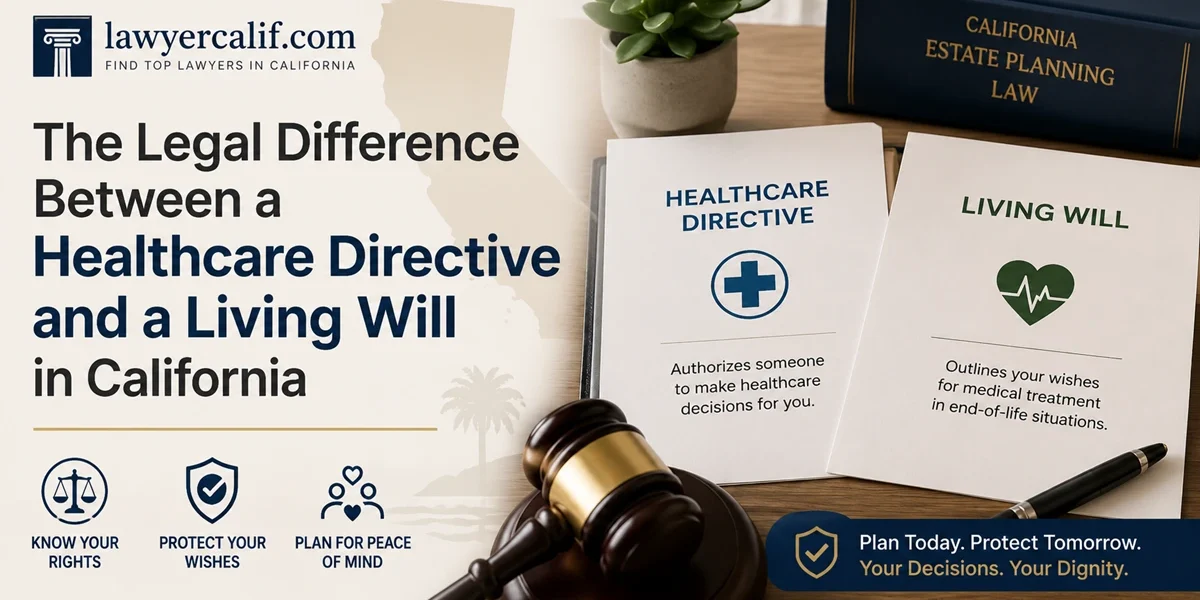
The Legal Difference Between a Healthcare Directive and a Living Will in California
Living Will vs. Advance Directive in California – When building an elder law plan in California, you will encounter a lot of legal jargon that sounds almost identical. Two terms that confuse seniors and their families the most are Living Wills and Advance Health Care Directives (AHCD).
Many people use these terms interchangeably. You might even see online “Do-It-Yourself” form websites selling them as two completely separate documents. CaringInfo
However, under the California Probate Code, there is a massive legal distinction. Bay Legal
If you try to use a standalone, generic “Living Will” in California, your family might still find themselves entirely locked out of the hospital room. Here is a breakdown of what these documents actually do, how California law handles them, and which one your family actually needs.
The Main Difference: An Umbrella vs. A Spoke
The easiest way to understand the difference is a simple rule of thumb: An Advance Health Care Directive is the comprehensive legal document, while a Living Will is just one section inside it. Davidson Estate Law
- Living Will: A static set of written instructions stating what treatments you want or do not want if you are terminally ill or permanently unconscious. It cannot adapt, and it does not name a person to speak for you. Davidson Estate Law +1
- Advance Health Care Directive: The official, legally recognized instrument in California. It combines your written medical wishes (the Living Will portion) and legally appoints a trusted person (your Healthcare Agent) to make real-time decisions for you. Bay Legal +1
In short: A Living Will says, “Here is my static list of medical preferences.” An Advance Directive says, “Here are my preferences, AND here is the exact human being I trust to enforce them if a doctor surprises us with something not on my list.” Davidson Estate Law
Why a Standalone “Living Will” Fails Under California Law
Historically, states used individual “Natural Death Act Declarations” or basic Living Wills. However, California updated its laws to create a unified framework under California Probate Code Section 4701. OC Office on Aging – Orange County
If an older adult relies solely on a traditional, standalone Living Will document, they run into three dangerous legal bottlenecks:
1. The Scope is Too Narrow
A traditional Living Will only activates under extreme, narrow circumstances: typically when a physician certifies you are in a persistent vegetative state, a permanent coma, or have a terminal illness. Davidson Estate Law
It does not protect a senior who is temporarily incapacitated by a severe stroke, heavily medicated after an unexpected fall, or experiencing advanced cognitive decline from Alzheimer’s disease. In those non-terminal scenarios, a Living Will remains completely dormant. Bay Legal
2. Paper Can’t Argue With a Doctor
A Living Will is a piece of paper, not an advocate. Medical situations are rarely black and white. If a doctor encounters a medical grey area or an unpredicted complication, a paper document cannot answer questions, look at new lab results, or weigh options. Bay Legal
3. No One Has Authority to Act
A Living Will does not grant anyone the legal power to sign hospital admission forms, choose a long-term rehabilitation facility, or access protected medical records under HIPAA.
The California Conservatorship Risk: As we established in our previous spoke, if a senior is incapacitated and only has a list of preferences but no designated healthcare agent, the family will likely have to sue for a court-ordered Conservatorship of the Person just to get the legal right to manage their care. Law Offices of Maria N. Jonsson, PC
The Superior Power of California’s Advance Health Care Directive
Because of the gaps left by a simple Living Will, California elder law professionals look to the Advance Health Care Directive. It is essentially two crucial safeguards rolled into one single document: Bay Legal +1
- Part 1: Durable Power of Attorney for Healthcare (The Agent): You legally designate an “attorney-in-fact” or agent. This person can dynamically look at real-time medical data, hire or fire doctors, and protect your quality of life. Davidson Estate Law +1
- Part 2: Individual Healthcare Instructions (The Living Will): This is the section where you spell out your direct rules regarding mechanical ventilation, cardiopulmonary resuscitation (CPR), artificial nutrition/hydration, and organ donation. Bay Legal
Quick Reference: Head-to-Head Comparison
| Feature | Standalone Living Will | California Advance Health Care Directive |
| Legal Status in CA | Recognized as instructions only, but largely outdated. | The official, legally binding standard. |
| Appoints an Agent? | ✗ No human advocate designated. | ✓ Yes, names primary and alternate agents. |
| When Does It Apply? | Only end-of-life or comatose states. | Any temporary or permanent incapacity. |
| Allows Real-Time Choice? | ✗ No, it is rigid and static. | ✓ Yes, your agent adapts to new treatments. |
| Avoids Court? | ✗ Not reliably if an advocate is needed. | ✓ Yes, keeps medical choices private and out of court. |
The Legality Test: Making it Valid in California
Simply writing down your wishes on a piece of paper or printing out a template does not make it a legally binding directive in California. To ensure your document holds up in a California hospital room during a crisis, it must meet strict statutory execution guidelines: California Department of Justice – CA.gov
- Capacity: The principal must be of sound mind and at least 18 years old when signing. Gibson & Tuttle – Roseville Trust & Probate Attorney
- Proper Execution: The document must either be signed by two qualified witnesses OR be stamped by a Notary Public. Davidson Estate Law
- Witness Restrictions: If you use witnesses, California law dictates that they cannot be your designated healthcare agent, your healthcare provider, or an operator of a community care facility. Furthermore, at least one of the witnesses must be someone who is not related to you by blood, marriage, or adoption, and who stands to inherit nothing from your estate. Davidson Estate Law
Which Document Do You Actually Need?
If you live in California, you do not need a separate standalone living will document. Instead, you need a comprehensive, legally compliant California Advance Health Care Directive that contains your explicit healthcare wishes alongside your agent designations. OC Office on Aging – Orange County +1
Are you ready to ensure your healthcare preferences are legally ironclad? Speak with an experienced California elder law attorney to draft an Advance Health Care Directive customized to your life, protecting your autonomy and sparing your family from guesswork during an emergency.
Explore More in Power of Attorney & Conservatorships:
Durable vs. General Power of Attorney
Learn what every California senior needs before a health crisis hits.
Read Article → Spoke 2How to Avoid a Court Conservatorship
Discover the Essential Incapacity Toolkit to keep control in your family.
Read Article → Spoke 3Dying or Incapacitated Without an Estate Plan
What happens when California Probate Court steps in by default.
Read Article →