
Understanding Shared Liability and Your Right to Compensation after an Injury
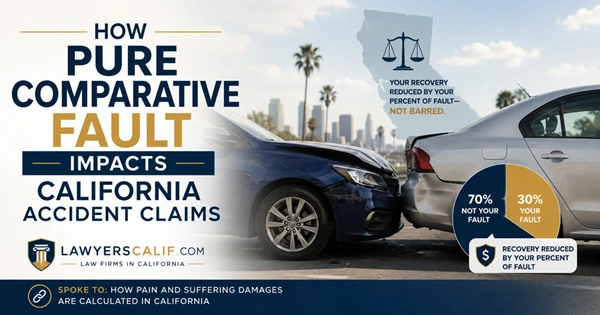
Pure Comparative Negligence – Following a sudden accident, the path to recovering financial compensation can quickly turn complicated. One of the most common tactics used by insurance adjusters to deny or minimize injury claims is attempting to shift the blame. They might argue that you were speeding when another car cut you off, or that you were distracted when you tripped on a hazard. In many states, if you are found to carry even a small percentage of blame for your own injuries, your case is completely thrown out. However, California operates under a highly victim-friendly legal doctrine known as pure comparative negligence. Under this system, sharing a portion of the blame does not automatically disqualify you from recovering compensation. This guide breaks down exactly how California’s comparative fault rules work, how insurance companies use them to protect their profits, and what you must do
to secure the maximum settlement value for your claim.
Table of Contents
1. What is Pure Comparative Negligence?
California’s approach to shared liability is governed by a “pure” comparative negligence standard. This legal doctrine dictating how shared blame alters a financial settlement is an essential pi lar of the state’s civil system, as outlined in our comprehensive master resource,
Personal Injury Law in California[cite: 1, 2]. “Pure” comparative negligence means that an injured party can legally pursue compensation from an at-fault entity regardless of their own percentage of blame [cite: 1, 2]. Whether you are 1% at
fault or 99% at fault, the legal system leaves the door open for you to file a claim [cite: 1, 2]. Instead of barring your recovery entirely, the court or the insurance adjusters wi l calculate your total financial damages and then reduce your final payout by your exact percentage of responsibility[cite: 1, 2].
The Financial Math: How It Works in Practice
To see how this doctrine operates in a real-world scenario, consider this example: Imagine you are driving through an intersection when another driver runs a red light and broadsides your vehicle. However, the data reveals you were driving 10 mph over the speed limit at the time of the crash.
- A jury determines that your total economic and non-economic damages equal $100,000[cite: 1, 2].
- Because you were speeding, the jury decides you are 25% responsible for the severity of the accident, while the driver who ran the red light is 75% responsible[cite: 1, 2].
- Under pure comparative fault rules, your final compensation award is reduced by 25% ($25,000)[cite: 1, 2].
- You wil ultimately receive $75,000 from the at-fault driver’s insurance policy[cite: 1, 2].
Because California has no “fault ceiling,” you could theoretically be deemed 90% responsible for an incident—perhaps by walking across an unlit highway at night away from a crosswalk—and sti l lega ly pursue the remaining 10% of your damages from a speeding motorist who struck you[cite: 1, 2].
2. Modified vs. Pure Comparative Negligence: Why California is Different
To truly appreciate the victim-friendly nature of California’s laws, it helps to understand how other states handle shared blame. Civil courts across the country generally use one of three systems:
- Contributory Negligence (The Deadliest Standard): Used in only a handful of jurisdictions, this rule states that if a victim is even 1% at fault for an accident, their right to compensation is entirely destroyed.
- Modified Comparative Fault (The 50% or 51% Bar): The majority of states use this rule. It a lows you to collect damages only if your share of the blame is less than 50% or 51%. If you hit that threshold, you collect absolutely nothing.
- Pure Comparative Fault (The California Standard): California completely rejects these arbitrary limits[cite: 1, 2]. The state believes that every negligent party should be held financially accountable for their exact share of the harm they caused.
3. How the Rule Changes Across Practice Areas
The doctrine of comparative negligence applies to almost every personal injury scenario in California, though it manifests differently depending on the specific type of accident.
Auto Accidents vs. Slip-and-Falls
In a car accident claim, comparative fault usua ly centers on driving behaviors—speeding, failing to signal, or sudden braking. In a premises liability case, the defense wi l look at your attention levels. They may try to pul your cel phone logs to prove you were texting while walking, arguing you would have seen the hazard if you had been looking forward.
The Intersection with Strict Liability Claims
Things get highly technical when comparative fault collides with strict liability laws. In cases involving defective consumer items or animal attacks, a victim does not need to prove the defendant acted carelessly to win, as established in our guide on Understanding Strict Liability vs. Negligence in California[cite: 1, 2]. However, a defendant can still use comparative fault to minimize their payout. For instance, under the rules detailed in California Dog Bite Laws & Owner Liability, an owner is strictly liable for a bite[cite: 1, 2]. But if the defense can prove you intentionally provoked the dog or ignored clear warning signs, a jury may assign you a percentage of fault, reducing your final check [cite:1, 2].
4. How Insurance Companies Weaponize Comparative Fault
Because every percentage point of fault shifted onto you saves the insurance company money, adjusters will aggressively search for ways to inflate your share of the blame. Immediately fo lowing an accident, an insurance representative may call you under the guise of “helping speed up your claim.” They wil ask for a recorded statement, often using friendly, conversational language designed to get you to lower your guard. They are looking for subtle admissions of guilt, such as:
- “I didn’t see him coming until the last second.” (They wil translate this to mean you were not paying attention).
- “I was in a bit of a rush to get home.” (They will use this to argue you were driving recklessly).
- “I had a minor ache in my neck before the crash.” (They will use this to argue your medical bi ls are tied to pre-existing conditions rather than the impact).
Manipulating these statements a lows insurance companies to artificially inflate your comparative fault percentage during settlement negotiations. If you accept a 30% fault determination without a fight, you are leaving thousands of dollars on the table.
5. How an Attorney Fights Unjust Blame Shifts
Protecting your settlement requires an intensive investigation to counter the insurance company’s assertions. A dedicated legal team wil combat these tactics by:
- Preserving Critical Evidence: Securing traffic camera footage, black box data from vehicles, and nearby business surveil lance to establish the objective facts of the crash before deadlines expire. To see how these statutory timelines work, read our brief on the California Personal Injury Statute of Limitations Explained[cite: 1, 2].
- Employing Accident Re-constructionists: Partnering with specialized engineering experts who can scientifically prove variables like vehicle speed, braking distance, and point of impact to defeat false allegations of speeding.
- Isolating Causation: Proving that even if you committed a minor technical infraction, it was not the actual or proximate cause of the accident.
Connect with a Local California Personal Injury Lawyer
Sorting out percentages of blame is rarely straightforward, and insurance companies count on your lack of legal knowledge to force unfair, lowball settlements. Because regional court systems and local jury pools evaluate fault arguments differently across various municipalities, having an expert on your side who understands your local legal layout is invaluable[cite: 1, 2]. Do not let an insurance adjuster dictate what your claim is worth. If you have been hurt in an accident, ensure your rights are aggressively defended by a professional. Explore our trusted, curated legal directory today to find a highly qualified, verified personal injury attorney in your local California community, and take control of your financial recovery[cite: 1, 2].